
协议设计与解析
大约 4 分钟
协议设计与解析
为什么需要协议?
TCP/IP 中消息传输基于流的方式,没有边界。
协议的目的就是划定消息的边界,制定通信双方要共同遵守的通信规则
例如:在网络上传输
下雨天留客天留我不留
是中文一句著名的无标点符号句子,在没有标点符号情况下,这句话有数种拆解方式,而意思却是完全不同,所以常被用作讲述标点符号的重要性
一种解读
下雨天留客,天留,我不留
另一种解读
下雨天,留客天,留我不?留
如何设计协议呢?其实就是给网络传输的信息加上“标点符号”。但通过分隔符来断句不是很好,因为分隔符本身如果用于传输,那么必须加以区分。因此,下面一种协议较为常用
定长字节表示内容长度 + 实际内容
例如,假设一个中文字符长度为 3,按照上述协议的规则,发送信息方式如下,就不会被接收方弄错意思了
0f下雨天留客06天留09我不留
redis 协议举例
NioEventLoopGroup worker = new NioEventLoopGroup();
byte[] LINE = {13, 10};
try {
    Bootstrap bootstrap = new Bootstrap();
    bootstrap.channel(NioSocketChannel.class);
    bootstrap.group(worker);
    bootstrap.handler(new ChannelInitializer<SocketChannel>() {
        @Override
        protected void initChannel(SocketChannel ch) {
            ch.pipeline().addLast(new LoggingHandler());
            ch.pipeline().addLast(new ChannelInboundHandlerAdapter() {
                // 会在连接 channel 建立成功后,会触发 active 事件
                @Override
                public void channelActive(ChannelHandlerContext ctx) {
                    set(ctx);
                    get(ctx);
                }
                private void get(ChannelHandlerContext ctx) {
                    ByteBuf buf = ctx.alloc().buffer();
                    buf.writeBytes("*2".getBytes());
                    buf.writeBytes(LINE);
                    buf.writeBytes("$3".getBytes());
                    buf.writeBytes(LINE);
                    buf.writeBytes("get".getBytes());
                    buf.writeBytes(LINE);
                    buf.writeBytes("$3".getBytes());
                    buf.writeBytes(LINE);
                    buf.writeBytes("aaa".getBytes());
                    buf.writeBytes(LINE);
                    ctx.writeAndFlush(buf);
                }
                private void set(ChannelHandlerContext ctx) {
                    ByteBuf buf = ctx.alloc().buffer();
                    buf.writeBytes("*3".getBytes());
                    buf.writeBytes(LINE);
                    buf.writeBytes("$3".getBytes());
                    buf.writeBytes(LINE);
                    buf.writeBytes("set".getBytes());
                    buf.writeBytes(LINE);
                    buf.writeBytes("$3".getBytes());
                    buf.writeBytes(LINE);
                    buf.writeBytes("aaa".getBytes());
                    buf.writeBytes(LINE);
                    buf.writeBytes("$3".getBytes());
                    buf.writeBytes(LINE);
                    buf.writeBytes("bbb".getBytes());
                    buf.writeBytes(LINE);
                    ctx.writeAndFlush(buf);
                }

                @Override
                public void channelRead(ChannelHandlerContext ctx, Object msg) throws Exception {
                    ByteBuf buf = (ByteBuf) msg;
                    System.out.println(buf.toString(Charset.defaultCharset()));
                }
            });
        }
    });
    ChannelFuture channelFuture = bootstrap.connect("localhost", 6379).sync();
    channelFuture.channel().closeFuture().sync();
} catch (InterruptedException e) {
    log.error("client error", e);
} finally {
    worker.shutdownGracefully();
}
http 协议举例
NioEventLoopGroup boss = new NioEventLoopGroup();
NioEventLoopGroup worker = new NioEventLoopGroup();
try {
    ServerBootstrap serverBootstrap = new ServerBootstrap();
    serverBootstrap.channel(NioServerSocketChannel.class);
    serverBootstrap.group(boss, worker);
    serverBootstrap.childHandler(new ChannelInitializer<SocketChannel>() {
        @Override
        protected void initChannel(SocketChannel ch) throws Exception {
            ch.pipeline().addLast(new LoggingHandler(LogLevel.DEBUG));
            ch.pipeline().addLast(new HttpServerCodec());
            ch.pipeline().addLast(new SimpleChannelInboundHandler<HttpRequest>() {
                @Override
                protected void channelRead0(ChannelHandlerContext ctx, HttpRequest msg) throws Exception {
                    // 获取请求
                    log.debug(msg.uri());

                    // 返回响应
                    DefaultFullHttpResponse response =
                            new DefaultFullHttpResponse(msg.protocolVersion(), HttpResponseStatus.OK);

                    byte[] bytes = "<h1>Hello, world!</h1>".getBytes();

                    response.headers().setInt(CONTENT_LENGTH, bytes.length);
                    response.content().writeBytes(bytes);

                    // 写回响应
                    ctx.writeAndFlush(response);
                }
            });
            /*ch.pipeline().addLast(new ChannelInboundHandlerAdapter() {
                @Override
                public void channelRead(ChannelHandlerContext ctx, Object msg) throws Exception {
                    log.debug("{}", msg.getClass());

                    if (msg instanceof HttpRequest) { // 请求行,请求头

                    } else if (msg instanceof HttpContent) { //请求体

                    }
                }
            });*/
        }
    });
    ChannelFuture channelFuture = serverBootstrap.bind(8080).sync();
    channelFuture.channel().closeFuture().sync();
} catch (InterruptedException e) {
    log.error("server error", e);
} finally {
    boss.shutdownGracefully();
    worker.shutdownGracefully();
}
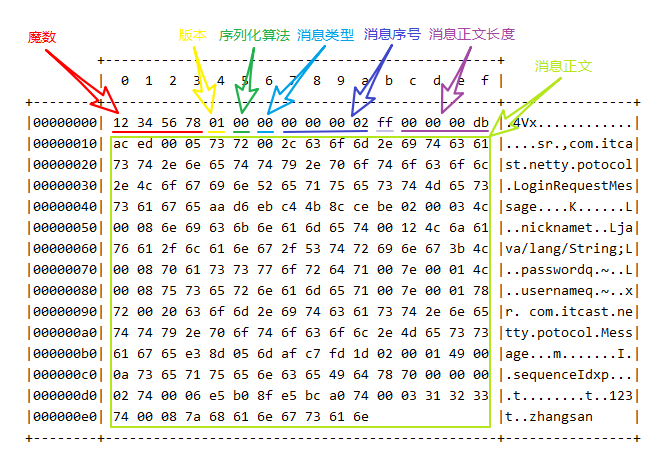
自定义协议要素
- 魔数,用来在第一时间判定是否是无效数据包
- 版本号,可以支持协议的升级
- 序列化算法,消息正文到底采用哪种序列化反序列化方式,可以由此扩展,例如:json、protobuf、hessian、jdk
- 指令类型,是登录、注册、单聊、群聊... 跟业务相关
- 请求序号,为了双工通信,提供异步能力
- 正文长度
- 消息正文
编解码器
根据上面的要素,设计一个登录请求消息和登录响应消息,并使用 Netty 完成收发
@Slf4j
public class MessageCodec extends ByteToMessageCodec<Message> {

    @Override
    protected void encode(ChannelHandlerContext ctx, Message msg, ByteBuf out) throws Exception {
        // 1. 4 字节的魔数
        out.writeBytes(new byte[]{1, 2, 3, 4});
        // 2. 1 字节的版本,
        out.writeByte(1);
        // 3. 1 字节的序列化方式 jdk 0 , json 1
        out.writeByte(0);
        // 4. 1 字节的指令类型
        out.writeByte(msg.getMessageType());
        // 5. 4 个字节
        out.writeInt(msg.getSequenceId());
        // 无意义,对齐填充
        out.writeByte(0xff);
        // 6. 获取内容的字节数组
        ByteArrayOutputStream bos = new ByteArrayOutputStream();
        ObjectOutputStream oos = new ObjectOutputStream(bos);
        oos.writeObject(msg);
        byte[] bytes = bos.toByteArray();
        // 7. 长度
        out.writeInt(bytes.length);
        // 8. 写入内容
        out.writeBytes(bytes);
    }

    @Override
    protected void decode(ChannelHandlerContext ctx, ByteBuf in, List<Object> out) throws Exception {
        int magicNum = in.readInt();
        byte version = in.readByte();
        byte serializerType = in.readByte();
        byte messageType = in.readByte();
        int sequenceId = in.readInt();
        in.readByte();
        int length = in.readInt();
        byte[] bytes = new byte[length];
        in.readBytes(bytes, 0, length);
        ObjectInputStream ois = new ObjectInputStream(new ByteArrayInputStream(bytes));
        Message message = (Message) ois.readObject();
        log.debug("{}, {}, {}, {}, {}, {}", magicNum, version, serializerType, messageType, sequenceId, length);
        log.debug("{}", message);
        out.add(message);
    }
}
测试
EmbeddedChannel channel = new EmbeddedChannel(
    new LoggingHandler(),
    new LengthFieldBasedFrameDecoder(
        1024, 12, 4, 0, 0),
    new MessageCodec()
);
// encode
LoginRequestMessage message = new LoginRequestMessage("zhangsan", "123", "张三");
//        channel.writeOutbound(message);
// decode
ByteBuf buf = ByteBufAllocator.DEFAULT.buffer();
new MessageCodec().encode(null, message, buf);

ByteBuf s1 = buf.slice(0, 100);
ByteBuf s2 = buf.slice(100, buf.readableBytes() - 100);
s1.retain(); // 引用计数 2
channel.writeInbound(s1); // release 1
channel.writeInbound(s2);
解读
@Sharable
Sharable是 io.netty.channel 包下面的一个注解,用来定义一个 handler 是否是线程安全的
- 当 handler 不保存状态时,就可以安全地在多线程下被共享
- 但要注意对于编解码器类,不能继承 ByteToMessageCodec 或 CombinedChannelDuplexHandler 父类,他们的构造方法对 @Sharable 有限制
- 如果能确保编解码器不会保存状态,可以继承 MessageToMessageCodec 父类