
Netty源码
Netty源码
参数优化
参数配置:
| TCP层 | Netty对象 | 方法 |
|---|---|---|
| ServerSocket | ServerSocketChannel | opetion() |
| Socket | SocketChannel | childOption() |
option() 控制 服务器入口, childOption() 控制 连接行为。
CONNECT_TIMEOUT_MILLIS
属于 SocketChannal 参数
用在客户端建立连接时,如果在指定毫秒内无法连接,会抛出 timeout 异常
SO_TIMEOUT 主要用在阻塞 IO,阻塞 IO 中 accept,read 等都是无限等待的,如果不希望永远阻塞,使用它调整超时时间
@Slf4j
public class TestConnectionTimeout {
    public static void main(String[] args) {
        NioEventLoopGroup group = new NioEventLoopGroup();
        try {
            Bootstrap bootstrap = new Bootstrap()
                    .group(group)
                    .option(ChannelOption.CONNECT_TIMEOUT_MILLIS, 300)
                    .channel(NioSocketChannel.class)
                    .handler(new LoggingHandler());
            ChannelFuture future = bootstrap.connect("127.0.0.1", 8080);
            future.sync().channel().closeFuture().sync(); // 断点1
        } catch (Exception e) {
            e.printStackTrace();
            log.debug("timeout");
        } finally {
            group.shutdownGracefully();
        }
    }
}
另外源码部分 io.netty.channel.nio.AbstractNioChannel.AbstractNioUnsafe#connect
@Override
public final void connect(
        final SocketAddress remoteAddress, final SocketAddress localAddress, final ChannelPromise promise) {
    // ...
    // Schedule connect timeout.
    int connectTimeoutMillis = config().getConnectTimeoutMillis();
    if (connectTimeoutMillis > 0) {
        connectTimeoutFuture = eventLoop().schedule(new Runnable() {
            @Override
            public void run() {
                ChannelPromise connectPromise = AbstractNioChannel.this.connectPromise;
                ConnectTimeoutException cause =
                    new ConnectTimeoutException("connection timed out: " + remoteAddress); // 断点2
                if (connectPromise != null && connectPromise.tryFailure(cause)) {
                    close(voidPromise());
                }
            }
        }, connectTimeoutMillis, TimeUnit.MILLISECONDS);
    }
	// ...
}
SO_BACKLOG
属于 ServerSocketChannal 参数
- 第一次握手,client 发送 SYN 到 server,状态修改为 SYN_SEND,server 收到,状态改变为 SYN_REVD,并将该请求放入 sync queue 队列
- 第二次握手,server 回复 SYN + ACK 给 client,client 收到,状态改变为 ESTABLISHED,并发送 ACK 给 server
- 第三次握手,server 收到 ACK,状态改变为 ESTABLISHED,将该请求从 sync queue 放入 accept queue
其中
在 linux 2.2 之前,backlog 大小包括了两个队列的大小,在 2.2 之后,分别用下面两个参数来控制
sync queue - 半连接队列
- 大小通过 /proc/sys/net/ipv4/tcp_max_syn_backlog 指定,在
syncookies启用的情况下,逻辑上没有最大值限制,这个设置便被忽略
- 大小通过 /proc/sys/net/ipv4/tcp_max_syn_backlog 指定,在
accept queue - 全连接队列
- 其大小通过 /proc/sys/net/core/somaxconn 指定,在使用 listen 函数时,内核会根据传入的 backlog 参数与系统参数,取二者的较小值
- 如果 accpet queue 队列满了,server 将发送一个拒绝连接的错误信息到 client
Netty 中
可以通过 option(ChannelOption.SO_BACKLOG, 值) 来设置大小
可以通过下面源码查看默认大小
public class DefaultServerSocketChannelConfig extends DefaultChannelConfig
                                              implements ServerSocketChannelConfig {

    private volatile int backlog = NetUtil.SOMAXCONN;
    // ...
}
调试关键断点为:
io.netty.channel.nio.NioEventLoop#processSelectedKeyoio 中更容易说明,不用 debug 模式
public class Server {
    public static void main(String[] args) throws IOException {
        ServerSocket ss = new ServerSocket(8888, 2);
        Socket accept = ss.accept();
        System.out.println(accept);
        System.in.read();
    }
}
客户端启动 4 个
public class Client {
    public static void main(String[] args) throws IOException {
        try {
            Socket s = new Socket();
            System.out.println(new Date()+" connecting...");
            s.connect(new InetSocketAddress("localhost", 8888),1000);
            System.out.println(new Date()+" connected...");
            s.getOutputStream().write(1);
            System.in.read();
        } catch (IOException e) {
            System.out.println(new Date()+" connecting timeout...");
            e.printStackTrace();
        }
    }
}
第 1,2,3 个客户端都打印,但除了第一个处于 accpet 外,其它两个都处于 accept queue 中
Tue Apr 21 20:30:28 CST 2020 connecting...
Tue Apr 21 20:30:28 CST 2020 connected...
第 4 个客户端连接时
Tue Apr 21 20:53:58 CST 2020 connecting...
Tue Apr 21 20:53:59 CST 2020 connecting timeout...
java.net.SocketTimeoutException: connect timed out
ulimit -n
操作系统参数,进程最多可以打开的文件描述符数量,linux默认1024
超过会发生什么?
java.io.IOException: Too many open files
Netty表现为:
- 新连接无法建立
- accept失败
- Redis/Kafka连接异常
- 服务看起来“随机挂”
推荐配置
常见配置:
ulimit -n 65535
高并发场景:
ulimit -n 200000
永久修改:
/etc/security/limits.conf
* soft nofile 65535
* hard nofile 65535
TCP_NODELAY
SocketChannal 参数,是否启用 Nagle 算法
Nagle 算法?
TCP 为了减少小包发送,会:
等待多个小数据包 → 合并 → 一次发送
目的:减少网络包数量,但是会增加延迟
Netty默认建议开启 TCP_NODELAY参数
ServerBootstrap bootstrap = new ServerBootstrap();

bootstrap
    .group(bossGroup, workerGroup)
    .channel(NioServerSocketChannel.class)
    .childOption(ChannelOption.TCP_NODELAY, true);

ChannelOption.TCP_NODELAY = true
关闭 Nagle 算法
Netty典型场景:
- RPC调用
- IM消息
- 实时数据
- 微服务调用
特点:
小包多 + 低延迟要求高
如果不开:
- 请求延迟增加
- RT抖动
- TPS下降
| 维度 | 开启 Nagle(默认) | 关闭 Nagle(TCP_NODELAY) |
|---|---|---|
| 目标 | 网络效率 | 低延迟 |
| 包数量 | 少 | 多 |
| 吞吐 | 高 | 略低 |
| 延迟 | 高 | 低 |
| 适合 | 文件传输 | RPC / Netty |
SO_SNDBUF & SO_RCVB
- SO_SNDBUF 属于 SocketChannal 参数
- SO_RCVBUF 既可用于 SocketChannal 参数,也可以用于 ServerSocketChannal 参数(建议设置到 ServerSocketChannal 上)
ALLOCATOR
- 属于 SocketChannal 参数
- 用来分配 ByteBuf, ctx.alloc()
RCVBUF_ALLOCATOR
- 属于 SocketChannal 参数
- 控制 netty 接收缓冲区大小
- 负责入站数据的分配,决定入站缓冲区的大小(并可动态调整),统一采用 direct 直接内存,具体池化还是非池化由 allocator 决定
源码
启动剖析
我们就来看看 netty 中对下面的代码是怎样进行处理的
//1 netty 中使用 NioEventLoopGroup (简称 nio boss 线程)来封装线程和 selector
Selector selector = Selector.open();

//2 创建 NioServerSocketChannel,同时会初始化它关联的 handler,以及为原生 ssc 存储 config
NioServerSocketChannel attachment = new NioServerSocketChannel();

//3 创建 NioServerSocketChannel 时,创建了 java 原生的 ServerSocketChannel
ServerSocketChannel serverSocketChannel = ServerSocketChannel.open();
serverSocketChannel.configureBlocking(false);

//4 启动 nio boss 线程执行接下来的操作

//5 注册(仅关联 selector 和 NioServerSocketChannel),未关注事件
SelectionKey selectionKey = serverSocketChannel.register(selector, 0, attachment);

//6 head -> 初始化器 -> ServerBootstrapAcceptor -> tail,初始化器是一次性的,只为添加 acceptor

//7 绑定端口
serverSocketChannel.bind(new InetSocketAddress(8080));

//8 触发 channel active 事件,在 head 中关注 op_accept 事件
selectionKey.interestOps(SelectionKey.OP_ACCEPT);
入口 io.netty.bootstrap.ServerBootstrap#bind
关键代码 io.netty.bootstrap.AbstractBootstrap#doBind
private ChannelFuture doBind(final SocketAddress localAddress) {
	// 1. 执行初始化和注册 regFuture 会由 initAndRegister 设置其是否完成,从而回调 3.2 处代码
    final ChannelFuture regFuture = initAndRegister();
    final Channel channel = regFuture.channel();
    if (regFuture.cause() != null) {
        return regFuture;
    }

    // 2. 因为是 initAndRegister 异步执行,需要分两种情况来看,调试时也需要通过 suspend 断点类型加以区分
    // 2.1 如果已经完成
    if (regFuture.isDone()) {
        ChannelPromise promise = channel.newPromise();
        // 3.1 立刻调用 doBind0
        doBind0(regFuture, channel, localAddress, promise);
        return promise;
    }
    // 2.2 还没有完成
    else {
        final PendingRegistrationPromise promise = new PendingRegistrationPromise(channel);
        // 3.2 回调 doBind0
        regFuture.addListener(new ChannelFutureListener() {
            @Override
            public void operationComplete(ChannelFuture future) throws Exception {
                Throwable cause = future.cause();
                if (cause != null) {
                    // 处理异常...
                    promise.setFailure(cause);
                } else {
                    promise.registered();
					// 3. 由注册线程去执行 doBind0
                    doBind0(regFuture, channel, localAddress, promise);
                }
            }
        });
        return promise;
    }
}
关键代码 io.netty.bootstrap.AbstractBootstrap#initAndRegister
final ChannelFuture initAndRegister() {
    Channel channel = null;
    try {
        channel = channelFactory.newChannel();
        // 1.1 初始化 - 做的事就是添加一个初始化器 ChannelInitializer
        init(channel);
    } catch (Throwable t) {
        // 处理异常...
        return new DefaultChannelPromise(new FailedChannel(), GlobalEventExecutor.INSTANCE).setFailure(t);
    }

    // 1.2 注册 - 做的事就是将原生 channel 注册到 selector 上
    ChannelFuture regFuture = config().group().register(channel);
    if (regFuture.cause() != null) {
        // 处理异常...
    }
    return regFuture;
}
关键代码 io.netty.bootstrap.ServerBootstrap#init
// 这里 channel 实际上是 NioServerSocketChannel
void init(Channel channel) throws Exception {
    final Map<ChannelOption<?>, Object> options = options0();
    synchronized (options) {
        setChannelOptions(channel, options, logger);
    }

    final Map<AttributeKey<?>, Object> attrs = attrs0();
    synchronized (attrs) {
        for (Entry<AttributeKey<?>, Object> e: attrs.entrySet()) {
            @SuppressWarnings("unchecked")
            AttributeKey<Object> key = (AttributeKey<Object>) e.getKey();
            channel.attr(key).set(e.getValue());
        }
    }

    ChannelPipeline p = channel.pipeline();

    final EventLoopGroup currentChildGroup = childGroup;
    final ChannelHandler currentChildHandler = childHandler;
    final Entry<ChannelOption<?>, Object>[] currentChildOptions;
    final Entry<AttributeKey<?>, Object>[] currentChildAttrs;
    synchronized (childOptions) {
        currentChildOptions = childOptions.entrySet().toArray(newOptionArray(0));
    }
    synchronized (childAttrs) {
        currentChildAttrs = childAttrs.entrySet().toArray(newAttrArray(0));
    }

    // 为 NioServerSocketChannel 添加初始化器
    p.addLast(new ChannelInitializer<Channel>() {
        @Override
        public void initChannel(final Channel ch) throws Exception {
            final ChannelPipeline pipeline = ch.pipeline();
            ChannelHandler handler = config.handler();
            if (handler != null) {
                pipeline.addLast(handler);
            }

            // 初始化器的职责是将 ServerBootstrapAcceptor 加入至 NioServerSocketChannel
            ch.eventLoop().execute(new Runnable() {
                @Override
                public void run() {
                    pipeline.addLast(new ServerBootstrapAcceptor(
                            ch, currentChildGroup, currentChildHandler, currentChildOptions, currentChildAttrs));
                }
            });
        }
    });
}
关键代码 io.netty.channel.AbstractChannel.AbstractUnsafe#register
public final void register(EventLoop eventLoop, final ChannelPromise promise) {
    // 一些检查,略...

    AbstractChannel.this.eventLoop = eventLoop;

    if (eventLoop.inEventLoop()) {
        register0(promise);
    } else {
        try {
            // 首次执行 execute 方法时,会启动 nio 线程,之后注册等操作在 nio 线程上执行
            // 因为只有一个 NioServerSocketChannel 因此,也只会有一个 boss nio 线程
            // 这行代码完成的事实是 main -> nio boss 线程的切换
            eventLoop.execute(new Runnable() {
                @Override
                public void run() {
                    register0(promise);
                }
            });
        } catch (Throwable t) {
            // 日志记录...
            closeForcibly();
            closeFuture.setClosed();
            safeSetFailure(promise, t);
        }
    }
}
io.netty.channel.AbstractChannel.AbstractUnsafe#register0
private void register0(ChannelPromise promise) {
    try {
        if (!promise.setUncancellable() || !ensureOpen(promise)) {
            return;
        }
        boolean firstRegistration = neverRegistered;
        // 1.2.1 原生的 nio channel 绑定到 selector 上,注意此时没有注册 selector 关注事件,附件为 NioServerSocketChannel
        doRegister();
        neverRegistered = false;
        registered = true;

        // 1.2.2 执行 NioServerSocketChannel 初始化器的 initChannel
        pipeline.invokeHandlerAddedIfNeeded();

        // 回调 3.2 io.netty.bootstrap.AbstractBootstrap#doBind0
        safeSetSuccess(promise);
        pipeline.fireChannelRegistered();

        // 对应 server socket channel 还未绑定,isActive 为 false
        if (isActive()) {
            if (firstRegistration) {
                pipeline.fireChannelActive();
            } else if (config().isAutoRead()) {
                beginRead();
            }
        }
    } catch (Throwable t) {
        // Close the channel directly to avoid FD leak.
        closeForcibly();
        closeFuture.setClosed();
        safeSetFailure(promise, t);
    }
}
关键代码 io.netty.channel.ChannelInitializer#initChannel
private boolean initChannel(ChannelHandlerContext ctx) throws Exception {
    if (initMap.add(ctx)) { // Guard against re-entrance.
        try {
            // 1.2.2.1 执行初始化
            initChannel((C) ctx.channel());
        } catch (Throwable cause) {
            exceptionCaught(ctx, cause);
        } finally {
            // 1.2.2.2 移除初始化器
            ChannelPipeline pipeline = ctx.pipeline();
            if (pipeline.context(this) != null) {
                pipeline.remove(this);
            }
        }
        return true;
    }
    return false;
}
关键代码 io.netty.bootstrap.AbstractBootstrap#doBind0
// 3.1 或 3.2 执行 doBind0
private static void doBind0(
        final ChannelFuture regFuture, final Channel channel,
        final SocketAddress localAddress, final ChannelPromise promise) {

    channel.eventLoop().execute(new Runnable() {
        @Override
        public void run() {
            if (regFuture.isSuccess()) {
                channel.bind(localAddress, promise).addListener(ChannelFutureListener.CLOSE_ON_FAILURE);
            } else {
                promise.setFailure(regFuture.cause());
            }
        }
    });
}
关键代码 io.netty.channel.AbstractChannel.AbstractUnsafe#bind
public final void bind(final SocketAddress localAddress, final ChannelPromise promise) {
    assertEventLoop();

    if (!promise.setUncancellable() || !ensureOpen(promise)) {
        return;
    }

    if (Boolean.TRUE.equals(config().getOption(ChannelOption.SO_BROADCAST)) &&
        localAddress instanceof InetSocketAddress &&
        !((InetSocketAddress) localAddress).getAddress().isAnyLocalAddress() &&
        !PlatformDependent.isWindows() && !PlatformDependent.maybeSuperUser()) {
        // 记录日志...
    }

    boolean wasActive = isActive();
    try {
        // 3.3 执行端口绑定
        doBind(localAddress);
    } catch (Throwable t) {
        safeSetFailure(promise, t);
        closeIfClosed();
        return;
    }

    if (!wasActive && isActive()) {
        invokeLater(new Runnable() {
            @Override
            public void run() {
                // 3.4 触发 active 事件
                pipeline.fireChannelActive();
            }
        });
    }

    safeSetSuccess(promise);
}
3.3 关键代码 io.netty.channel.socket.nio.NioServerSocketChannel#doBind
protected void doBind(SocketAddress localAddress) throws Exception {
    if (PlatformDependent.javaVersion() >= 7) {
        javaChannel().bind(localAddress, config.getBacklog());
    } else {
        javaChannel().socket().bind(localAddress, config.getBacklog());
    }
}
3.4 关键代码 io.netty.channel.DefaultChannelPipeline.HeadContext#channelActive
public void channelActive(ChannelHandlerContext ctx) {
    ctx.fireChannelActive();
	// 触发 read (NioServerSocketChannel 上的 read 不是读取数据,只是为了触发 channel 的事件注册)
    readIfIsAutoRead();
}
关键代码 io.netty.channel.nio.AbstractNioChannel#doBeginRead
protected void doBeginRead() throws Exception {
    // Channel.read() or ChannelHandlerContext.read() was called
    final SelectionKey selectionKey = this.selectionKey;
    if (!selectionKey.isValid()) {
        return;
    }

    readPending = true;

    final int interestOps = selectionKey.interestOps();
    // readInterestOp 取值是 16,在 NioServerSocketChannel 创建时初始化好,代表关注 accept 事件
    if ((interestOps & readInterestOp) == 0) {
        selectionKey.interestOps(interestOps | readInterestOp);
    }
}
2.2 NioEventLoop 剖析
NioEventLoop 线程不仅要处理 IO 事件,还要处理 Task(包括普通任务和定时任务),
提交任务代码 io.netty.util.concurrent.SingleThreadEventExecutor#execute
public void execute(Runnable task) {
    if (task == null) {
        throw new NullPointerException("task");
    }

    boolean inEventLoop = inEventLoop();
    // 添加任务,其中队列使用了 jctools 提供的 mpsc 无锁队列
    addTask(task);
    if (!inEventLoop) {
        // inEventLoop 如果为 false 表示由其它线程来调用 execute,即首次调用,这时需要向 eventLoop 提交首个任务,启动死循环,会执行到下面的 doStartThread
        startThread();
        if (isShutdown()) {
            // 如果已经 shutdown,做拒绝逻辑,代码略...
        }
    }

    if (!addTaskWakesUp && wakesUpForTask(task)) {
        // 如果线程由于 IO select 阻塞了,添加的任务的线程需要负责唤醒 NioEventLoop 线程
        wakeup(inEventLoop);
    }
}
唤醒 select 阻塞线程io.netty.channel.nio.NioEventLoop#wakeup
@Override
protected void wakeup(boolean inEventLoop) {
    if (!inEventLoop && wakenUp.compareAndSet(false, true)) {
        selector.wakeup();
    }
}
启动 EventLoop 主循环 io.netty.util.concurrent.SingleThreadEventExecutor#doStartThread
private void doStartThread() {
    assert thread == null;
    executor.execute(new Runnable() {
        @Override
        public void run() {
            // 将线程池的当前线程保存在成员变量中,以便后续使用
            thread = Thread.currentThread();
            if (interrupted) {
                thread.interrupt();
            }

            boolean success = false;
            updateLastExecutionTime();
            try {
                // 调用外部类 SingleThreadEventExecutor 的 run 方法,进入死循环,run 方法见下
                SingleThreadEventExecutor.this.run();
                success = true;
            } catch (Throwable t) {
                logger.warn("Unexpected exception from an event executor: ", t);
            } finally {
				// 清理工作,代码略...
            }
        }
    });
}
io.netty.channel.nio.NioEventLoop#run 主要任务是执行死循环,不断看有没有新任务,有没有 IO 事件
protected void run() {
    for (;;) {
        try {
            try {
                // calculateStrategy 的逻辑如下:
                // 有任务,会执行一次 selectNow,清除上一次的 wakeup 结果,无论有没有 IO 事件,都会跳过 switch
                // 没有任务,会匹配 SelectStrategy.SELECT,看是否应当阻塞
                switch (selectStrategy.calculateStrategy(selectNowSupplier, hasTasks())) {
                    case SelectStrategy.CONTINUE:
                        continue;

                    case SelectStrategy.BUSY_WAIT:

                    case SelectStrategy.SELECT:
                        // 因为 IO 线程和提交任务线程都有可能执行 wakeup,而 wakeup 属于比较昂贵的操作,因此使用了一个原子布尔对象 wakenUp,它取值为 true 时,表示该由当前线程唤醒
                        // 进行 select 阻塞,并设置唤醒状态为 false
                        boolean oldWakenUp = wakenUp.getAndSet(false);

                        // 如果在这个位置,非 EventLoop 线程抢先将 wakenUp 置为 true,并 wakeup
                        // 下面的 select 方法不会阻塞
                        // 等 runAllTasks 处理完成后,到再循环进来这个阶段新增的任务会不会及时执行呢?
                        // 因为 oldWakenUp 为 true,因此下面的 select 方法就会阻塞,直到超时
                        // 才能执行,让 select 方法无谓阻塞
                        select(oldWakenUp);

                        if (wakenUp.get()) {
                            selector.wakeup();
                        }
                    default:
                }
            } catch (IOException e) {
                rebuildSelector0();
                handleLoopException(e);
                continue;
            }

            cancelledKeys = 0;
            needsToSelectAgain = false;
            // ioRatio 默认是 50
            final int ioRatio = this.ioRatio;
            if (ioRatio == 100) {
                try {
                    processSelectedKeys();
                } finally {
                    // ioRatio 为 100 时,总是运行完所有非 IO 任务
                    runAllTasks();
                }
            } else {
                final long ioStartTime = System.nanoTime();
                try {
                    processSelectedKeys();
                } finally {
                    // 记录 io 事件处理耗时
                    final long ioTime = System.nanoTime() - ioStartTime;
                    // 运行非 IO 任务,一旦超时会退出 runAllTasks
                    runAllTasks(ioTime * (100 - ioRatio) / ioRatio);
                }
            }
        } catch (Throwable t) {
            handleLoopException(t);
        }
        try {
            if (isShuttingDown()) {
                closeAll();
                if (confirmShutdown()) {
                    return;
                }
            }
        } catch (Throwable t) {
            handleLoopException(t);
        }
    }
}
⚠️ 注意
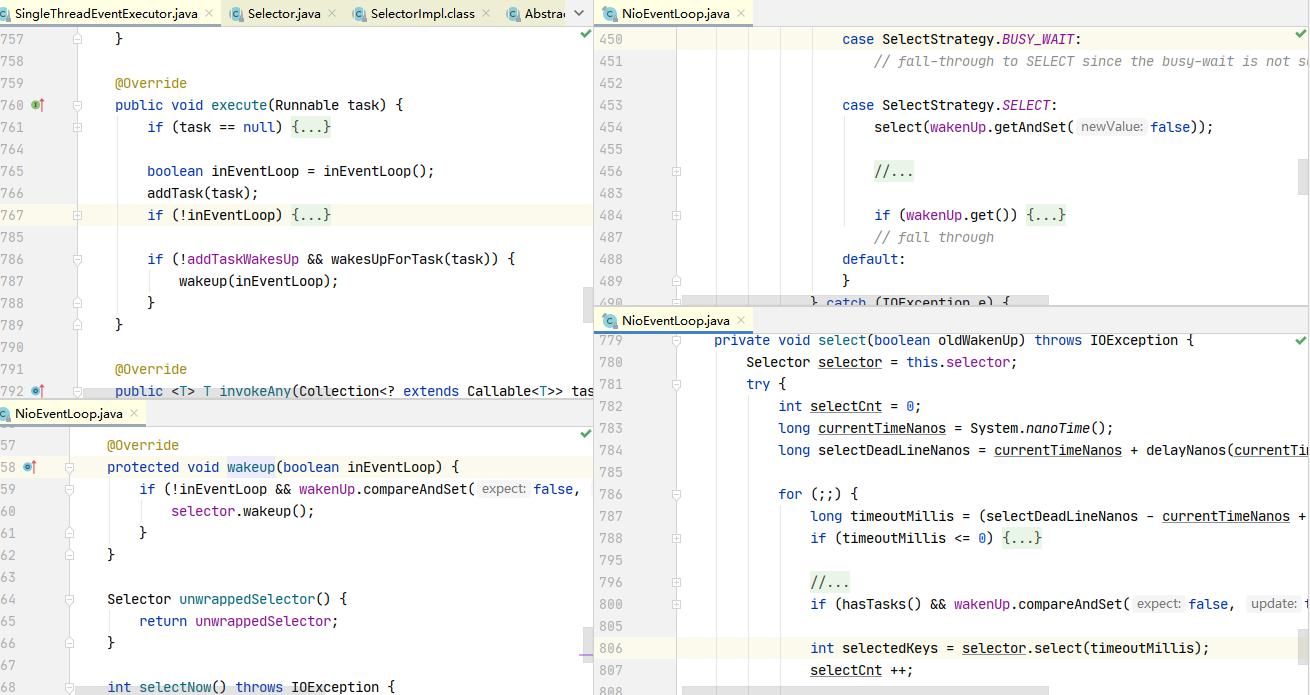
这里有个费解的地方就是 wakeup,它既可以由提交任务的线程来调用(比较好理解),也可以由 EventLoop 线程来调用(比较费解),这里要知道 wakeup 方法的效果:
- 由非 EventLoop 线程调用,会唤醒当前在执行 select 阻塞的 EventLoop 线程
- 由 EventLoop 自己调用,会本次的 wakeup 会取消下一次的 select 操作
参考下图
io.netty.channel.nio.NioEventLoop#select
private void select(boolean oldWakenUp) throws IOException {
    Selector selector = this.selector;
    try {
        int selectCnt = 0;
        long currentTimeNanos = System.nanoTime();
        // 计算等待时间
        // * 没有 scheduledTask,超时时间为 1s
        // * 有 scheduledTask,超时时间为 `下一个定时任务执行时间 - 当前时间`
        long selectDeadLineNanos = currentTimeNanos + delayNanos(currentTimeNanos);

        for (;;) {
            long timeoutMillis = (selectDeadLineNanos - currentTimeNanos + 500000L) / 1000000L;
            // 如果超时,退出循环
            if (timeoutMillis <= 0) {
                if (selectCnt == 0) {
                    selector.selectNow();
                    selectCnt = 1;
                }
                break;
            }

            // 如果期间又有 task 退出循环,如果没这个判断,那么任务就会等到下次 select 超时时才能被执行
            // wakenUp.compareAndSet(false, true) 是让非 NioEventLoop 不必再执行 wakeup
            if (hasTasks() && wakenUp.compareAndSet(false, true)) {
                selector.selectNow();
                selectCnt = 1;
                break;
            }

            // select 有限时阻塞
            // 注意 nio 有 bug,当 bug 出现时,select 方法即使没有时间发生,也不会阻塞住,导致不断空轮询,cpu 占用 100%
            int selectedKeys = selector.select(timeoutMillis);
            // 计数加 1
            selectCnt ++;

            // 醒来后,如果有 IO 事件、或是由非 EventLoop 线程唤醒,或者有任务,退出循环
            if (selectedKeys != 0 || oldWakenUp || wakenUp.get() || hasTasks() || hasScheduledTasks()) {
                break;
            }
            if (Thread.interrupted()) {
               	// 线程被打断,退出循环
                // 记录日志
                selectCnt = 1;
                break;
            }

            long time = System.nanoTime();
            if (time - TimeUnit.MILLISECONDS.toNanos(timeoutMillis) >= currentTimeNanos) {
                // 如果超时,计数重置为 1,下次循环就会 break
                selectCnt = 1;
            }
            // 计数超过阈值,由 io.netty.selectorAutoRebuildThreshold 指定,默认 512
            // 这是为了解决 nio 空轮询 bug
            else if (SELECTOR_AUTO_REBUILD_THRESHOLD > 0 &&
                    selectCnt >= SELECTOR_AUTO_REBUILD_THRESHOLD) {
                // 重建 selector
                selector = selectRebuildSelector(selectCnt);
                selectCnt = 1;
                break;
            }

            currentTimeNanos = time;
        }

        if (selectCnt > MIN_PREMATURE_SELECTOR_RETURNS) {
            // 记录日志
        }
    } catch (CancelledKeyException e) {
        // 记录日志
    }
}
处理 keys io.netty.channel.nio.NioEventLoop#processSelectedKeys
private void processSelectedKeys() {
    if (selectedKeys != null) {
        // 通过反射将 Selector 实现类中的就绪事件集合替换为 SelectedSelectionKeySet
        // SelectedSelectionKeySet 底层为数组实现,可以提高遍历性能(原本为 HashSet)
        processSelectedKeysOptimized();
    } else {
        processSelectedKeysPlain(selector.selectedKeys());
    }
}
io.netty.channel.nio.NioEventLoop#processSelectedKey
private void processSelectedKey(SelectionKey k, AbstractNioChannel ch) {
    final AbstractNioChannel.NioUnsafe unsafe = ch.unsafe();
    // 当 key 取消或关闭时会导致这个 key 无效
    if (!k.isValid()) {
        // 无效时处理...
        return;
    }

    try {
        int readyOps = k.readyOps();
        // 连接事件
        if ((readyOps & SelectionKey.OP_CONNECT) != 0) {
            int ops = k.interestOps();
            ops &= ~SelectionKey.OP_CONNECT;
            k.interestOps(ops);

            unsafe.finishConnect();
        }

        // 可写事件
        if ((readyOps & SelectionKey.OP_WRITE) != 0) {
            ch.unsafe().forceFlush();
        }

        // 可读或可接入事件
        if ((readyOps & (SelectionKey.OP_READ | SelectionKey.OP_ACCEPT)) != 0 || readyOps == 0) {
            // 如果是可接入 io.netty.channel.nio.AbstractNioMessageChannel.NioMessageUnsafe#read
            // 如果是可读 io.netty.channel.nio.AbstractNioByteChannel.NioByteUnsafe#read
            unsafe.read();
        }
    } catch (CancelledKeyException ignored) {
        unsafe.close(unsafe.voidPromise());
    }
}
2.3 accept 剖析
nio 中如下代码,在 netty 中的流程
//1 阻塞直到事件发生
selector.select();

Iterator<SelectionKey> iter = selector.selectedKeys().iterator();
while (iter.hasNext()) {
    //2 拿到一个事件
    SelectionKey key = iter.next();

    //3 如果是 accept 事件
    if (key.isAcceptable()) {

        //4 执行 accept
        SocketChannel channel = serverSocketChannel.accept();
        channel.configureBlocking(false);

        //5 关注 read 事件
        channel.register(selector, SelectionKey.OP_READ);
    }
    // ...
}
先来看可接入事件处理(accept)
io.netty.channel.nio.AbstractNioMessageChannel.NioMessageUnsafe#read
public void read() {
    assert eventLoop().inEventLoop();
    final ChannelConfig config = config();
    final ChannelPipeline pipeline = pipeline();
    final RecvByteBufAllocator.Handle allocHandle = unsafe().recvBufAllocHandle();
    allocHandle.reset(config);

    boolean closed = false;
    Throwable exception = null;
    try {
        try {
            do {
				// doReadMessages 中执行了 accept 并创建 NioSocketChannel 作为消息放入 readBuf
                // readBuf 是一个 ArrayList 用来缓存消息
                int localRead = doReadMessages(readBuf);
                if (localRead == 0) {
                    break;
                }
                if (localRead < 0) {
                    closed = true;
                    break;
                }
				// localRead 为 1,就一条消息,即接收一个客户端连接
                allocHandle.incMessagesRead(localRead);
            } while (allocHandle.continueReading());
        } catch (Throwable t) {
            exception = t;
        }

        int size = readBuf.size();
        for (int i = 0; i < size; i ++) {
            readPending = false;
            // 触发 read 事件,让 pipeline 上的 handler 处理,这时是处理
            // io.netty.bootstrap.ServerBootstrap.ServerBootstrapAcceptor#channelRead
            pipeline.fireChannelRead(readBuf.get(i));
        }
        readBuf.clear();
        allocHandle.readComplete();
        pipeline.fireChannelReadComplete();

        if (exception != null) {
            closed = closeOnReadError(exception);

            pipeline.fireExceptionCaught(exception);
        }

        if (closed) {
            inputShutdown = true;
            if (isOpen()) {
                close(voidPromise());
            }
        }
    } finally {
        if (!readPending && !config.isAutoRead()) {
            removeReadOp();
        }
    }
}
关键代码 io.netty.bootstrap.ServerBootstrap.ServerBootstrapAcceptor#channelRead
public void channelRead(ChannelHandlerContext ctx, Object msg) {
    // 这时的 msg 是 NioSocketChannel
    final Channel child = (Channel) msg;

    // NioSocketChannel 添加  childHandler 即初始化器
    child.pipeline().addLast(childHandler);

    // 设置选项
    setChannelOptions(child, childOptions, logger);

    for (Entry<AttributeKey<?>, Object> e: childAttrs) {
        child.attr((AttributeKey<Object>) e.getKey()).set(e.getValue());
    }

    try {
        // 注册 NioSocketChannel 到 nio worker 线程,接下来的处理也移交至 nio worker 线程
        childGroup.register(child).addListener(new ChannelFutureListener() {
            @Override
            public void operationComplete(ChannelFuture future) throws Exception {
                if (!future.isSuccess()) {
                    forceClose(child, future.cause());
                }
            }
        });
    } catch (Throwable t) {
        forceClose(child, t);
    }
}
又回到了熟悉的 io.netty.channel.AbstractChannel.AbstractUnsafe#register 方法
public final void register(EventLoop eventLoop, final ChannelPromise promise) {
    // 一些检查,略...

    AbstractChannel.this.eventLoop = eventLoop;

    if (eventLoop.inEventLoop()) {
        register0(promise);
    } else {
        try {
            // 这行代码完成的事实是 nio boss -> nio worker 线程的切换
            eventLoop.execute(new Runnable() {
                @Override
                public void run() {
                    register0(promise);
                }
            });
        } catch (Throwable t) {
            // 日志记录...
            closeForcibly();
            closeFuture.setClosed();
            safeSetFailure(promise, t);
        }
    }
}
io.netty.channel.AbstractChannel.AbstractUnsafe#register0
private void register0(ChannelPromise promise) {
    try {
        if (!promise.setUncancellable() || !ensureOpen(promise)) {
            return;
        }
        boolean firstRegistration = neverRegistered;
        doRegister();
        neverRegistered = false;
        registered = true;

        // 执行初始化器,执行前 pipeline 中只有 head -> 初始化器 -> tail
        pipeline.invokeHandlerAddedIfNeeded();
        // 执行后就是 head -> logging handler -> my handler -> tail

        safeSetSuccess(promise);
        pipeline.fireChannelRegistered();

        if (isActive()) {
            if (firstRegistration) {
                // 触发 pipeline 上 active 事件
                pipeline.fireChannelActive();
            } else if (config().isAutoRead()) {
                beginRead();
            }
        }
    } catch (Throwable t) {
        closeForcibly();
        closeFuture.setClosed();
        safeSetFailure(promise, t);
    }
}
回到了熟悉的代码 io.netty.channel.DefaultChannelPipeline.HeadContext#channelActive
public void channelActive(ChannelHandlerContext ctx) {
    ctx.fireChannelActive();
	// 触发 read (NioSocketChannel 这里 read,只是为了触发 channel 的事件注册,还未涉及数据读取)
    readIfIsAutoRead();
}
io.netty.channel.nio.AbstractNioChannel#doBeginRead
protected void doBeginRead() throws Exception {
    // Channel.read() or ChannelHandlerContext.read() was called
    final SelectionKey selectionKey = this.selectionKey;
    if (!selectionKey.isValid()) {
        return;
    }

    readPending = true;
	// 这时候 interestOps 是 0
    final int interestOps = selectionKey.interestOps();
    if ((interestOps & readInterestOp) == 0) {
        // 关注 read 事件
        selectionKey.interestOps(interestOps | readInterestOp);
    }
}
2.4 read 剖析
再来看可读事件 io.netty.channel.nio.AbstractNioByteChannel.NioByteUnsafe#read,注意发送的数据未必能够一次读完,因此会触发多次 nio read 事件,一次事件内会触发多次 pipeline read,一次事件会触发一次 pipeline read complete
public final void read() {
    final ChannelConfig config = config();
    if (shouldBreakReadReady(config)) {
        clearReadPending();
        return;
    }
    final ChannelPipeline pipeline = pipeline();
    // io.netty.allocator.type 决定 allocator 的实现
    final ByteBufAllocator allocator = config.getAllocator();
    // 用来分配 byteBuf,确定单次读取大小
    final RecvByteBufAllocator.Handle allocHandle = recvBufAllocHandle();
    allocHandle.reset(config);

    ByteBuf byteBuf = null;
    boolean close = false;
    try {
        do {
            byteBuf = allocHandle.allocate(allocator);
            // 读取
            allocHandle.lastBytesRead(doReadBytes(byteBuf));
            if (allocHandle.lastBytesRead() <= 0) {
                byteBuf.release();
                byteBuf = null;
                close = allocHandle.lastBytesRead() < 0;
                if (close) {
                    readPending = false;
                }
                break;
            }

            allocHandle.incMessagesRead(1);
            readPending = false;
            // 触发 read 事件,让 pipeline 上的 handler 处理,这时是处理 NioSocketChannel 上的 handler
            pipeline.fireChannelRead(byteBuf);
            byteBuf = null;
        }
        // 是否要继续循环
        while (allocHandle.continueReading());

        allocHandle.readComplete();
        // 触发 read complete 事件
        pipeline.fireChannelReadComplete();

        if (close) {
            closeOnRead(pipeline);
        }
    } catch (Throwable t) {
        handleReadException(pipeline, byteBuf, t, close, allocHandle);
    } finally {
        if (!readPending && !config.isAutoRead()) {
            removeReadOp();
        }
    }
}
io.netty.channel.DefaultMaxMessagesRecvByteBufAllocator.MaxMessageHandle#continueReading(io.netty.util.UncheckedBooleanSupplier)
public boolean continueReading(UncheckedBooleanSupplier maybeMoreDataSupplier) {
    return
           // 一般为 true
           config.isAutoRead() &&
           // respectMaybeMoreData 默认为 true
           // maybeMoreDataSupplier 的逻辑是如果预期读取字节与实际读取字节相等,返回 true
           (!respectMaybeMoreData || maybeMoreDataSupplier.get()) &&
           // 小于最大次数,maxMessagePerRead 默认 16
           totalMessages < maxMessagePerRead &&
           // 实际读到了数据
           totalBytesRead > 0;
}