
泛型
大约 3 分钟
泛型
泛型(Generics),是指在类定义时不指定类中信息的具体数据类型,而是暂时用一个标识符来替代,当外部实例化对象的时候再来指定具体的数据类型。
//定义 A 类的时候就指定了属性是 B 类型
public class A{
    private B b;
    public C test(D d){
        return new C();
    }
}
//定义 A 类的时候不指定属性的类型
public class A<T,E,M>{
    private T b;
    public E test(M m){
        return E;
    }
}

A<B,C,D> a = new A();
优点:这样做极大地提升程序的灵活性,提升类的扩展性,泛型可以指代类中成员变量的数据类型,方法的返回值类型以及方法的参数类型。
1、泛型的应用
自定义类中添加泛型
public class 类名<泛型1,泛型2,泛型3...>{
	private 泛型1 属性名;
	public 泛型2 方法名(泛型3){
		方法体
	}
}
public class Time<T> {
    private T value;

    public T getValue() {
        return value;
    }

    public void setValue(T value) {
        this.value = value;
    }
}
public class Test {
    public static void main(String[] args) {
        Time<Integer> time1 = new Time<>();
        time1.setValue(10);
        System.out.println("现在的时间是"+time1.getValue());
        Time<String> time2 = new Time<>();
        time2.setValue("十点整");
        System.out.println("现在的时间是"+time2.getValue());
    }
}
泛型用哪个字母都可以,关键是类定义处的字母和类中信息的字母保持一致。
public class Time<H,M,S> {
    private H hour;
    private M minute;
    private S second;

    public H getHour() {
        return hour;
    }

    public void setHour(H hour) {
        this.hour = hour;
    }

    public M getMinute() {
        return minute;
    }

    public void setMinute(M minute) {
        this.minute = minute;
    }

    public S getSecond() {
        return second;
    }

    public void setSecond(S second) {
        this.second = second;
    }
}
public class Test {
    public static void main(String[] args) {
        Time<String,Integer,Float> time = new Time<>();
        time.setHour("十点");
        time.setMinute(10);
        time.setSecond(10.0f);
        System.out.println("现在的时间是"+time.getHour()+":"+time.getMinute()+":"+time.getSecond());
    }
}
2、泛型通配符
有一个参数为 ArrayList 的方法,希望这个方法即可接收泛型是 String 的集合,又可以接收泛型是 Integer 的集合,怎么实现?
多态在泛型中不适用
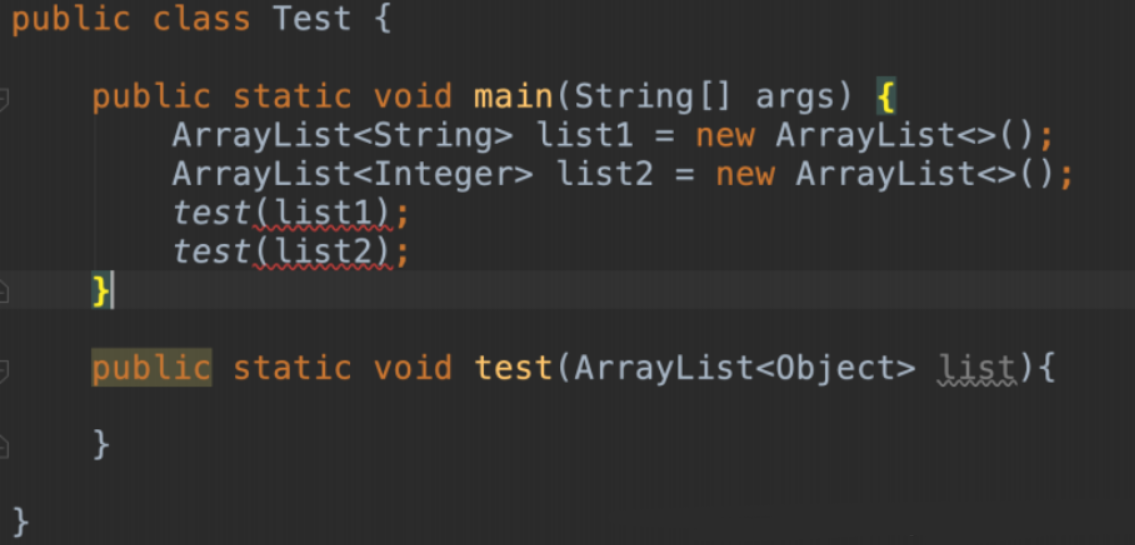
public class Test {

    public static void main(String[] args) {
        ArrayList<String> list1 = new ArrayList<>();
        ArrayList<Integer> list2 = new ArrayList<>();
        test(list1);
        test(list2);
    }

    public static void test(ArrayList<?> list){
        System.out.println(list);
    }

}
ArrayList<?> 表示可以使用任意的泛型类型对象,这样 test 方法具备通用性了。
3、泛型上限和下限
上限:表示实例化时具体的数据类型,可以是上限类型的子类或者是上限类型本身,用 extends 表示。
下限:表示实例化时具体的数据类型,可以是下限类型的父类或者是下限类型本身,用 super 表示。
类名<泛型标识 extends 上限类名>
类名<泛型标识 super 下限类名>
public class Time<T> {

    public static void main(String[] args) {
        test(new Time<Float>());
        test(new Time<Integer>());
        test(new Time<Number>());

        test2(new Time<String>());
        test2(new Time<Object>());
    }

    /**
     * 泛型上限
     * @param time
     */
    public static void test(Time<? extends Number> time){

    }

    /**
     * 泛型下限
     * @param time
     */
    public static void test2(Time<? super String> time) {

    }
}
4、泛型接口
接口
public interface MyInterface<T> {
    public T getValue();
}
实现泛型接口有两种方式:
- 实现类在定义时继续使用泛型标识
public class MyInterfaceImpl<T> implements MyInterface  {

    private T obj;

    public MyInterfaceImpl(T obj) {
        this.obj = obj;
    }

    @Override
    public T getValue() {
        return this.obj;
    }
}
- 实现类在定义时直接给出具体的数据类型
package com.du.demo;

public class MyInterfaceImpl2 implements MyInterface<String> {

    private String obj;

    public MyInterfaceImpl2(String obj) {
        this.obj = obj;
    }

    @Override
    public String getValue() {
        return this.obj;
    }
}
public class Test {

    public static void main(String[] args) {

        MyInterfaceImpl myInterface = new MyInterfaceImpl<String>("接口");
        String val = (String) myInterface.getValue();

        MyInterfaceImpl2 myInterface1 = new MyInterfaceImpl2("接口");
        val = myInterface1.getValue();
    }
}