
使用Redisson
大约 4 分钟
使用Redisson
导入依赖
<!-- https://mvnrepository.com/artifact/org.redisson/redisson-spring-boot-starter -->
<dependency>
    <groupId>org.redisson</groupId>
    <artifactId>redisson-spring-boot-starter</artifactId>
    <version>3.15.6</version>
</dependency>
配置redisson.yml
singleServerConfig:
    idleConnectionTimeout: 10000
    #pingTimeout: 1000
    connectTimeout: 10000
    timeout: 3000
    retryAttempts: 3
    retryInterval: 1500
    #reconnectionTimeout: 3000
    #failedAttempts: 3
    password: root
    subscriptionsPerConnection: 5
    clientName: null
    address: "redis://192.168.190.138:6379"
    subscriptionConnectionMinimumIdleSize: 1
    subscriptionConnectionPoolSize: 50
    connectionMinimumIdleSize: 32
    connectionPoolSize: 64
    database: 0
    #dnsMonitoring: false
    dnsMonitoringInterval: 5000
threads: 0
nettyThreads: 0
codec: !<org.redisson.codec.JsonJacksonCodec> {}
transportMode : "NIO"
添加配置类
package com.du.config;

import org.redisson.Redisson;
import org.redisson.api.RedissonClient;
import org.redisson.config.Config;
import org.springframework.context.annotation.Bean;
import org.springframework.context.annotation.Configuration;
import org.springframework.core.io.ClassPathResource;

import java.io.IOException;

/**
 * @author mozzie
 */
@Configuration
public class RedissonConfig {

    @Bean(destroyMethod="shutdown")
    public RedissonClient redisson() throws IOException {
        //两种方式
        //1、导入YAML文件
        RedissonClient redisson = Redisson.create(
                Config.fromYAML(new ClassPathResource("redisson-single.yml").getInputStream()));
        return redisson;

        //2、创建Config类,配置参数
        Config config = new Config();
        config.useSingleServer()
                .setAddress("redis://192.168.190.140:6379")
                .setDatabase(0)
                .setPassword("root");
        config.setLockWatchdogTimeout(15000);
        return Redisson.create(config);
    }
}
测试
@Autowired
RedissonClient redissonClient;

@PostMapping("/redissonlock")
public String redissonlock(@RequestParam String name) {

    // 加锁,添加key
    String lock = name + "-lock";
    RLock rLock = redissonClient.getLock(lock);

    try {
        rLock.lock();
        int apple = Integer.parseInt(Objects.requireNonNull(stringRedisTemplate.opsForValue().get(name)));
        if (apple > 0) {
            apple--;
            System.out.println("---------扣减成功," + name + "库存:" + apple);
            stringRedisTemplate.opsForValue().set("apple", String.valueOf(apple));
        } else {
            System.out.println("---------库存不足,扣减失败");
        }
    } finally {
        // 解锁,删除key
        rLock.unlock();
    }
    return "";
}
watchdog
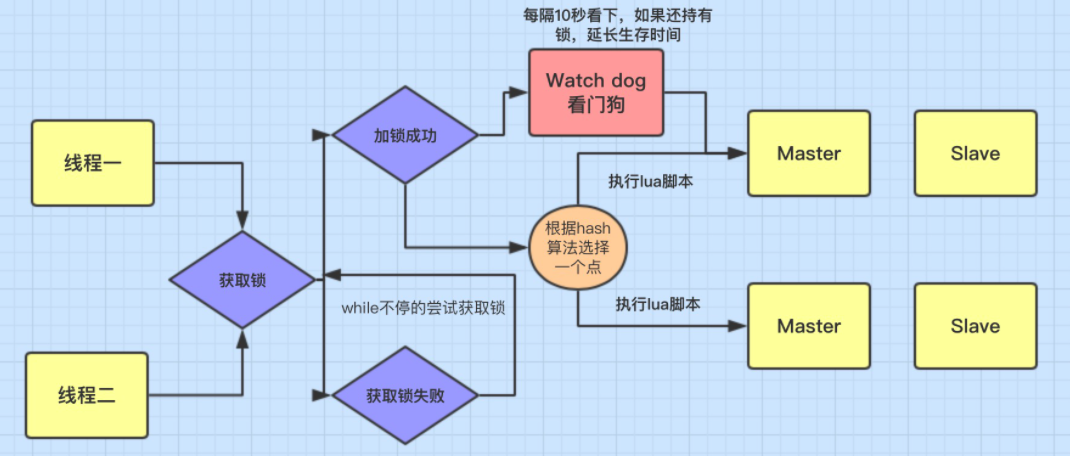
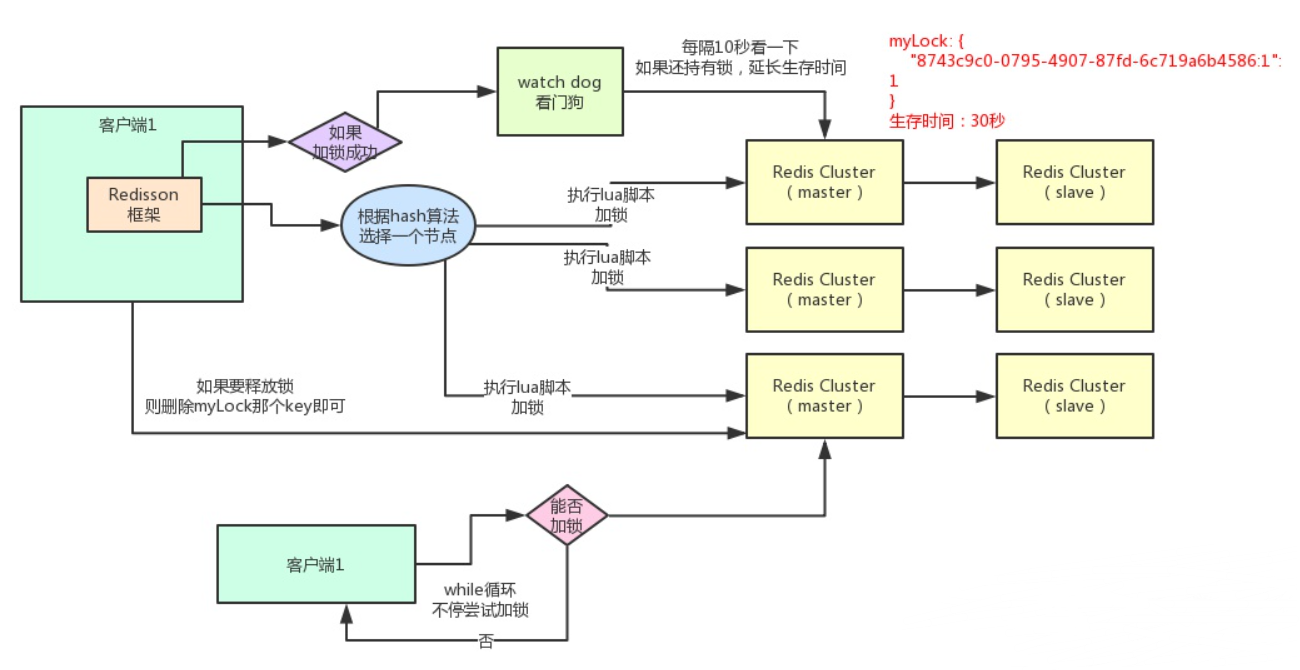
看门狗,redisson不指定leaseTime,默认创建一个30秒的看门狗。
核心源码
// 直接使用lock无参数方法
public void lock() {
    try {
        lock(-1, null, false);
    } catch (InterruptedException e) {
        throw new IllegalStateException();
    }
}

// 进入该方法 其中leaseTime = -1
private void lock(long leaseTime, TimeUnit unit, boolean interruptibly) throws InterruptedException {
    long threadId = Thread.currentThread().getId();
    Long ttl = tryAcquire(-1, leaseTime, unit, threadId);
    // lock acquired
    if (ttl == null) {
        return;
    }

   //...
}

// 进入 tryAcquire(-1, leaseTime, unit, threadId)
private Long tryAcquire(long waitTime, long leaseTime, TimeUnit unit, long threadId) {
    return get(tryAcquireAsync(waitTime, leaseTime, unit, threadId));
}

// 进入 tryAcquireAsync
private <T> RFuture<Long> tryAcquireAsync(long waitTime, long leaseTime, TimeUnit unit, long threadId) {
    if (leaseTime != -1) {
        return tryLockInnerAsync(waitTime, leaseTime, unit, threadId, RedisCommands.EVAL_LONG);
    }
    //当leaseTime = -1 时 启动 watch dog机制
    RFuture<Long> ttlRemainingFuture = tryLockInnerAsync(waitTime,
                                            commandExecutor.getConnectionManager().getCfg().getLockWatchdogTimeout(),
                                            TimeUnit.MILLISECONDS, threadId, RedisCommands.EVAL_LONG);
    //执行完lua脚本后的回调
    ttlRemainingFuture.onComplete((ttlRemaining, e) -> {
        if (e != null) {
            return;
        }

        if (ttlRemaining == null) {
            // watch dog
            scheduleExpirationRenewal(threadId);
        }
    });
    return ttlRemainingFuture;
}
scheduleExpirationRenewal 方法开启监控:
private void scheduleExpirationRenewal(long threadId) {
    ExpirationEntry entry = new ExpirationEntry();
    //将线程放入缓存中
    ExpirationEntry oldEntry = EXPIRATION_RENEWAL_MAP.putIfAbsent(getEntryName(), entry);
    //第二次获得锁后 不会进行延期操作
    if (oldEntry != null) {
        oldEntry.addThreadId(threadId);
    } else {
        entry.addThreadId(threadId);

        // 第一次获得锁 延期操作
        renewExpiration();
    }
}

// 进入 renewExpiration()
private void renewExpiration() {
    ExpirationEntry ee = EXPIRATION_RENEWAL_MAP.get(getEntryName());
    //如果缓存不存在,那不再锁续期
    if (ee == null) {
        return;
    }

    Timeout task = commandExecutor.getConnectionManager().newTimeout(new TimerTask() {
        @Override
        public void run(Timeout timeout) throws Exception {
            ExpirationEntry ent = EXPIRATION_RENEWAL_MAP.get(getEntryName());
            if (ent == null) {
                return;
            }
            Long threadId = ent.getFirstThreadId();
            if (threadId == null) {
                return;
            }

            //执行lua 进行续期
            RFuture<Boolean> future = renewExpirationAsync(threadId);
            future.onComplete((res, e) -> {
                if (e != null) {
                    log.error("Can't update lock " + getName() + " expiration", e);
                    return;
                }

                if (res) {
                    //延期成功,继续循环操作
                    renewExpiration();
                }
            });
        }
        //每隔internalLockLeaseTime/3=10秒检查一次
    }, internalLockLeaseTime / 3, TimeUnit.MILLISECONDS);

    ee.setTimeout(task);
}

//lua脚本 执行包装好的lua脚本进行key续期
protected RFuture<Boolean> renewExpirationAsync(long threadId) {
    return evalWriteAsync(getName(), LongCodec.INSTANCE, RedisCommands.EVAL_BOOLEAN,
            "if (redis.call('hexists', KEYS[1], ARGV[2]) == 1) then " +
                    "redis.call('pexpire', KEYS[1], ARGV[1]); " +
                    "return 1; " +
                    "end; " +
                    "return 0;",
            Collections.singletonList(getName()),
            internalLockLeaseTime, getLockName(threadId));
}
结论:
- watch dog 在当前节点存活时每10s给分布式锁的key续期 30s;
- watch dog 机制启动,且代码中没有释放锁操作时,watch dog 会不断的给锁续期;
- 从可2得出,如果程序释放锁操作时因为异常没有被执行,那么锁无法被释放,所以释放锁操作一定要放到 finally {} 中;
看到3的时候,可能会有人有疑问,如果释放锁操作本身异常了,watch dog 不会继续续期
// 锁释放
public void unlock() {
    try {
        get(unlockAsync(Thread.currentThread().getId()));
    } catch (RedisException e) {
        if (e.getCause() instanceof IllegalMonitorStateException) {
            throw (IllegalMonitorStateException) e.getCause();
        } else {
            throw e;
        }
    }
}

// 进入 unlockAsync(Thread.currentThread().getId()) 方法 入参是当前线程的id
public RFuture<Void> unlockAsync(long threadId) {
    RPromise<Void> result = new RedissonPromise<Void>();
    //执行lua脚本 删除key
    RFuture<Boolean> future = unlockInnerAsync(threadId);

    future.onComplete((opStatus, e) -> {
        // 无论执行lua脚本是否成功 执行cancelExpirationRenewal(threadId) 方法来删除EXPIRATION_RENEWAL_MAP中的缓存
        cancelExpirationRenewal(threadId);

        if (e != null) {
            result.tryFailure(e);
            return;
        }

        if (opStatus == null) {
            IllegalMonitorStateException cause = new IllegalMonitorStateException("attempt to unlock lock, not locked by current thread by node id: "
                    + id + " thread-id: " + threadId);
            result.tryFailure(cause);
            return;
        }

        result.trySuccess(null);
    });

    return result;
}

// 此方法会停止 watch dog 机制
void cancelExpirationRenewal(Long threadId) {
    ExpirationEntry task = EXPIRATION_RENEWAL_MAP.get(getEntryName());
    if (task == null) {
        return;
    }

    if (threadId != null) {
        task.removeThreadId(threadId);
    }

    if (threadId == null || task.hasNoThreads()) {
        Timeout timeout = task.getTimeout();
        if (timeout != null) {
            timeout.cancel();
        }
        EXPIRATION_RENEWAL_MAP.remove(getEntryName());
    }
}
释放锁的操作中 有一步操作是从 EXPIRATION_RENEWAL_MAP 中获取 ExpirationEntry 对象,然后将其remove,结合watch dog中的续期前的判断:
EXPIRATION_RENEWAL_MAP.get(getEntryName());
if (ent == null) {
    return;
}
可以得出结论:
如果释放锁操作本身异常了,watch dog 还会不停的续期吗?不会,因为无论释放锁操作是否成功,EXPIRATION_RENEWAL_MAP中的目标 ExpirationEntry 对象已经被移除了,watch dog 通过判断后就不会继续给锁续期了。